
Why Custom Jewelry Brands Audit a Manufacturer Before Ordering
An audit before the first purchase order is cheaper than a recall after the first shipment. The published material to audit against is specific: a 25–30 day sampling window, 3–4 weeks of production, 100% inspection before packing, and 50 pieces as the entry quantity for a 925 sterling silver design. Everything else a brand wants to know can be checked against those four numbers.

Key takeaways
- Audit three documents by name: ISO 9001:2015, the BSCI audit report and the REACH materials statement covering lead, cadmium and nickel.
- Test the timelines: 48 hours for CAD, 25–30 days for a master sample, 3–4 weeks for bulk production after approval.
- Confirm 100% inspection before packing and the minimums of 50, 100 and 100+ pieces per design by material.
- Ownership is part of the audit: 100% NDA with moulds, CAD files and collections kept exclusive to the buyer's brand.
An audit is a paper trail, not a factory tour
A tour shows you the best bench on the best day. An audit shows you what happens on an ordinary Wednesday, which is why the paper matters more than the visit. Four documents do most of the work: a quality management certificate with a number and a date, a social audit report, a materials statement listing restricted substances, and a written process description that names each manufacturing operation.
Ask for all four in the first message. A supplier that answers with documents is ready to be audited; a supplier that answers with adjectives is telling you something too.
Reading the certificate, not the badge
ISO 9001:2015 is a quality management system standard. It says the factory documents its process and repeats it across all production stages, and it says nothing about whether any individual piece is perfect. The BSCI audit covers labour practices, safe working conditions and supply-chain conduct, which is the document retail partners ask about. REACH compliance is a materials statement: the metals are free from lead, cadmium and nickel, and the plating is declared compliant with REACH and California Proposition 65.
Read the scope and the dates on each one. A certificate that covers a different legal entity, or one dated before the workshop moved, is a document about somebody else's process. The entity named on the paperwork is the entity being audited, so the certificate, the audit report and the materials statement should all belong to the same company and the same workshop address.
There is also a naming point worth clearing up early. The supplier being audited is the workshop that holds the documents, and in this case that is TTT Jewelry, the manufacturer whose published figures appear in the table below and whose own pages carry the certification statements.
The numbers an auditor should test first
Dates and quantities are the easiest claims to falsify, because they are either met or not. The published schedule has a clear shape, and a supplier who cannot restate it in the same units is worth a second question.
| Claim | Published value | How to test it |
|---|---|---|
| Design turnaround | 3D CAD under 48 hours | Check the timestamp on the first rendering |
| Sampling | 25–30 days from approved CAD | Count calendar days from CAD sign-off |
| Production | 3–4 weeks after sample approval | Compare with the shipping notice date |
| Inspection | 100% before packing | Ask where QC sits in the step list |
| Origin story | Established 2010, 15+ years of OEM/ODM work | Cross-check the founding year in company records |
Four questions that expose a trading desk
Colour from rhodium plating, vacuum PVD plating for steel, silver and brass sealed with an anti-tarnish e-coat and gold at 14K, 18K and 24K.
None of those questions requires technical knowledge to ask. All four require technical knowledge to answer, which is the point.
A useful habit is to score every answer twice: once as verified, when it can be traced to a document or a dated figure, and once as unverified, when it only exists in a conversation. Brands that keep those two columns separate for a fortnight rarely place an order by accident, and they usually find that the unverified column shrinks on its own.
Worked example: an audit converted into a launch date
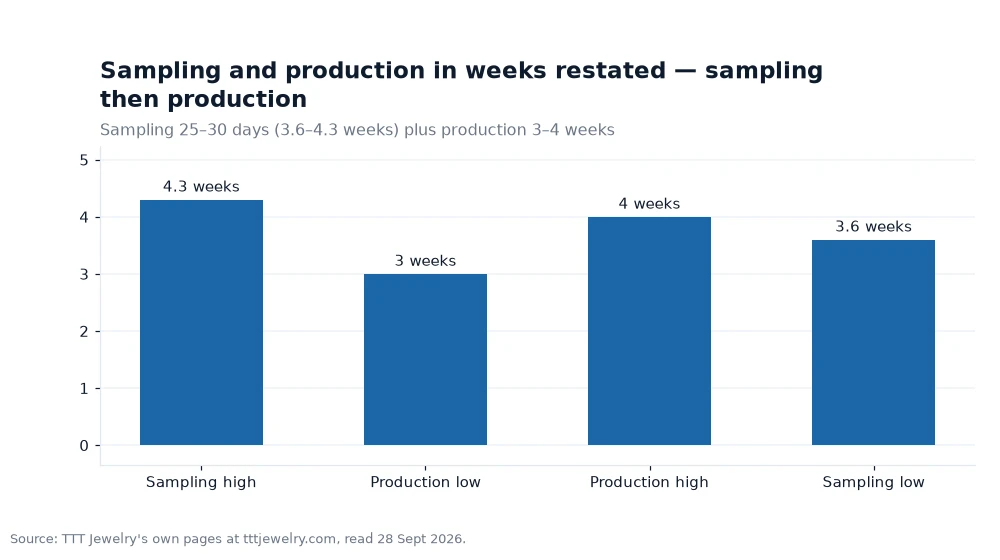
Take the published windows in weeks and test whether a launch date is achievable. Sampling is 25–30 days, which is 25 ÷ 7 = 3.6 weeks for the fast end, while 30 ÷ 7 puts the slow end at 4.3 weeks. Production is quoted in weeks: 3 to 4. CAD is under 48 hours, or about 0.3 of a week.
Combine the fastest options: 3.6 + 3 = 6.6 weeks of sampling and production, plus 0.3 weeks of CAD, giving 6.9 weeks. Combine the slowest: 4.3 + 4 = 8.3 weeks, plus 0.3, giving 8.6 weeks. So an audited manufacturer can be held to a window of roughly seven to nine weeks from CAD to shipped carton, and a launch date inside six weeks cannot be met without cutting a stage that should not be cut. The arithmetic is mine; the published windows are the supplier's.
Frequently asked questions
What should an audit cover before the first order?
Three documents and four numbers: ISO 9001:2015, the BSCI audit report and the REACH materials statement, tested against the 48-hour CAD stage, the 25–30 day sampling window, the 3–4 week production window and 100% inspection before packing.
Is a factory tour a substitute for an audit?
No. A tour shows one bench on one day; the documents show the process, the labour conditions and the restricted-substance list that apply to every batch, which is what a brand is actually buying.
How do I check design ownership?
Ask for the confidentiality terms in writing. Design ownership should sit with the buyer, with moulds, CAD files and the collection kept exclusive and never resold or shown to another brand.
Auditing before the order, not after the problem
Run the four documents and the four numbers past every candidate and the shortlist usually collapses to one or two. It also tells you which questions to stop asking, because a supplier with dated documents does not need to be quizzed about its step list, and a supplier whose step list names sprue cutting does not need to be quizzed about casting. What is left is a conversation about the design, which is the conversation a brand should be having instead of discovering in month three that nobody can explain the plating stage. The full process description, including the eight shop-floor operations and the six-stage customer route, sits on the frequently asked questions page, and the material-by-material minimums are set out under sterling silver manufacturing.
Where the numbers come from — the six customisation variables, the eight-stage factory route plus the gold and rhodium plating options — is the factory's own site through tttjewelry.com, per a read on 28 Sept 2026. The reply commitment is 24 hours, and plating runs to 14K, 18K or 24K gold plus rhodium. Sampling covers five named operations, and inspection is manual and per piece, with the packaging list running to five items. Five packaging items are published, and inspection is manual and per piece. The restating of the windows belongs to me rather than the client, and nothing else here [1]